
 Enquiry
Jet Hand Dryers Manufactuer and Suplier in Delhi
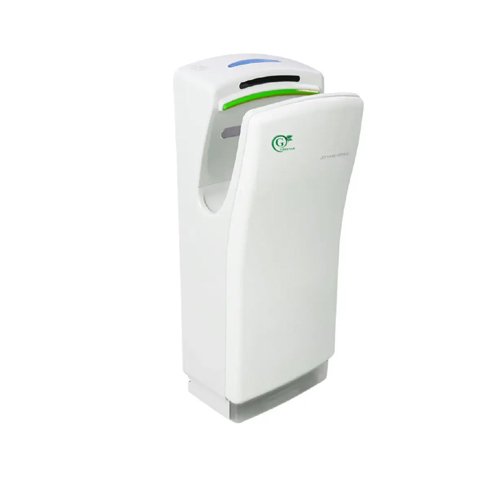
Stand near a busy washroom in a Delhi mall or a large corporate lobby during peak hours and it's obvious pretty fast why a slow hand dryer is a problem — people either queue, shake their hands dry and walk off with wet fingers, or reach for a towel that isn't there. Jet hand dryers exist specifically to solve that bottleneck. Instead of relying mainly on warm air evaporating moisture over 15-25 seconds, a jet dryer uses a high-RPM brushless motor to generate a narrow, high-velocity airstream that physically blows the water off the skin, cutting the whole process down to roughly 5-10 seconds.
That speed comes from the motor and airflow design, not just a stronger fan. Brushless motors run at high RPM — commonly in the range of 18,000 RPM — pushing air through a narrow outlet at speeds well above what a standard dryer produces, sometimes exceeding 90-95 m/s. The body is usually molded ABS or polycarbonate, sealed to handle the airflow pressure and the washroom environment without the housing flexing or cracking over time.
The other detail that separates decent jet dryers from cheap ones is filtration. A number of models on the market now include a HEPA filter stage, which matters in washrooms where hygiene is a real purchasing criterion — hospitals, hotels, food-service facilities — since it filters bacteria out of the air stream before it reaches the user's hands rather than just blowing washroom air straight at them.
In Delhi, the buyers looking specifically for jet dryers over standard automatic units are usually the ones with a genuine throughput problem: malls, cinema complexes, large corporate campuses, airports-adjacent commercial spaces, and hotels running high guest turnover. If your washroom sees moderate traffic, a standard ABS automatic dryer does the job for less money — jet dryers earn their premium specifically where speed and volume matter.
Why Choose Jet Hand Dryers — Feature List
- High-velocity airstream for fast drying Air speed of [Confirm: 90-95+ m/s] means hands dry in roughly 5-10 seconds rather than the 15-25 seconds typical of a standard automatic dryer — the difference that actually matters in a high-traffic washroom.
- Brushless motor construction Brushless motors run cooler, last longer under continuous daily cycling, and operate more quietly than brushed motors — a meaningful difference in a unit that might trigger hundreds of times a day in a busy washroom.
- HEPA filtration (on select models) Where fitted, a HEPA filter stage removes a significant portion of airborne bacteria from the output air, which matters specifically in hospitals, hotels, and food-service washrooms where hygiene is a stated purchasing requirement, not just a nice-to-have.
- Sealed ABS or polycarbonate housing Built to handle the internal air pressure of a high-speed motor without flexing or cracking, and to resist the same corrosion and impact issues that affect any washroom fixture over years of daily use.
- Infrared sensor activation Same contact-free trigger as a standard automatic dryer — hands under the outlet activate the airstream automatically, with auto cut-off after a set delay once hands are withdrawn.
- Hot/cold air switch on select models Several jet dryer models include a switch or default setting for heated vs. unheated airflow, useful where energy cost or user preference favors skipping the heating element.
- Compact wall-mounted footprint Despite the more powerful motor, jet dryers are generally built to a similar wall-mounted footprint as standard dryers, so retrofitting an existing washroom doesn't usually require structural changes.
- Reduced noise relative to older high-speed models Newer brushless-motor jet dryers run notably quieter than older brushed-motor high-speed units — worth confirming the decibel rating specifically if the washroom is small or acoustically enclosed.
Why Choose Jet Hand Dryers
- High-velocity airstream for fast drying Air speed of [Confirm: 90-95+ m/s] means hands dry in roughly 5-10 seconds rather than the 15-25 seconds typical of a standard automatic dryer — the difference that actually matters in a high-traffic washroom.
- Brushless motor construction Brushless motors run cooler, last longer under continuous daily cycling, and operate more quietly than brushed motors — a meaningful difference in a unit that might trigger hundreds of times a day in a busy washroom.
- HEPA filtration (on select models) Where fitted, a HEPA filter stage removes a significant portion of airborne bacteria from the output air, which matters specifically in hospitals, hotels, and food-service washrooms where hygiene is a stated purchasing requirement, not just a nice-to-have.
- Sealed ABS or polycarbonate housing Built to handle the internal air pressure of a high-speed motor without flexing or cracking, and to resist the same corrosion and impact issues that affect any washroom fixture over years of daily use.
- Infrared sensor activation Same contact-free trigger as a standard automatic dryer — hands under the outlet activate the airstream automatically, with auto cut-off after a set delay once hands are withdrawn.
- Hot/cold air switch on select models Several jet dryer models include a switch or default setting for heated vs. unheated airflow, useful where energy cost or user preference favors skipping the heating element.
- Compact wall-mounted footprint Despite the more powerful motor, jet dryers are generally built to a similar wall-mounted footprint as standard dryers, so retrofitting an existing washroom doesn't usually require structural changes.
- Reduced noise relative to older high-speed models Newer brushless-motor jet dryers run notably quieter than older brushed-motor high-speed units — worth confirming the decibel rating specifically if the washroom is small or acoustically enclosed.
Applications / Use Cases
- Malls and cinema complexes. High-footfall washrooms where queuing at the dryer is a real, visible problem during peak hours — this is the clearest use case for jet over standard dryers.
- Hotels and hospitality. Guest washrooms where a faster, more premium-feeling drying experience matters, often paired with HEPA-filtered models for hygiene-conscious properties.
- Hospitals and clinics. Washrooms where filtered airflow and speed both matter — HEPA-equipped jet dryers are increasingly specified here over standard units.
- Corporate offices and large campuses. Washrooms serving hundreds of staff at shift-change or lunch peaks, where throughput genuinely affects washroom wait times.
- Airports, transit hubs, and large public facilities. Constant, high-volume use where motor durability and drying speed both matter more than in a typical office washroom.
Why Source From a Delhi-Based Manufacturer
Sourcing locally in Delhi means shorter lead times for facilities that need washrooms upgraded before a specific opening or peak season, the ability to inspect a sample unit's noise level and build quality in person before a bulk order, and a supplier who understands the voltage and installation norms used across Delhi commercial buildings.