
Stainless Steel Dustbin Buying Guide for Every Space | Greenar
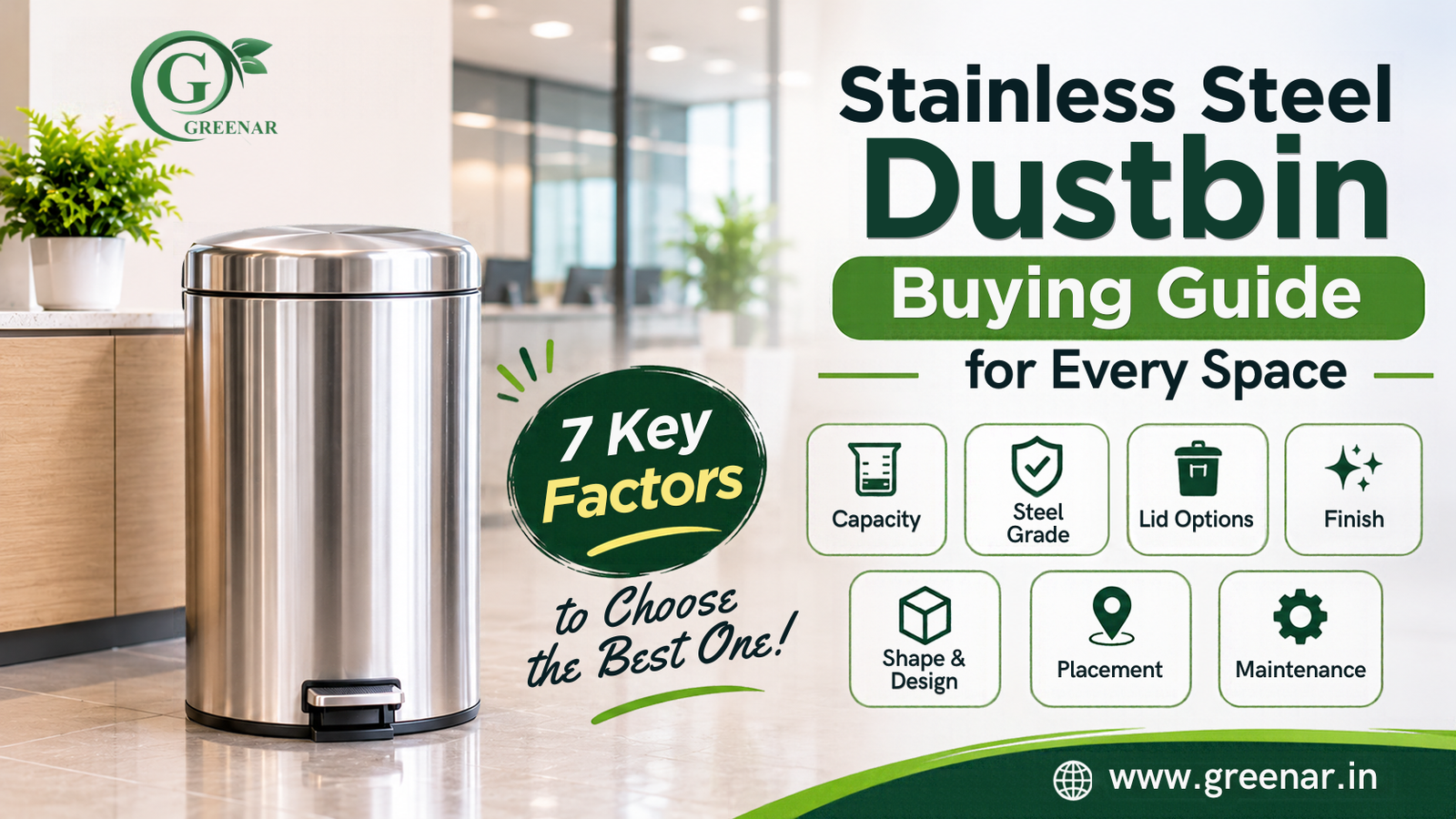
Stainless Steel Dustbin Buying Guide for Every Space
You have a spare corner, a rough budget and a dozen tabs open, all showing steel bins that look nearly the same. They aren't the same. Seven things separate stainless steel dustbins that serve you for years from ones you replace after a monsoon, and this guide walks through them in the order that matters.
Greenar manufactures stainless steel dustbins in sizes from 5 to 80 litres, so the examples below come from what we actually make. The advice itself holds wherever you buy.
1. Capacity: size stainless steel dustbins for the waste point, not the room
Most people pick a size by looking at the room. Pick it by looking at the waste. A kitchen that cooks twice a day fills a bin far faster than a bedroom that produces a few tissues.
A useful test is how often you're willing to empty it. If you want to empty it daily, choose a size that is nearly full by evening. A bin that is too big sits half empty and starts to smell before it fills, and one that is too small overflows by lunch.
For reference, Greenar's perforated bins start at 5 to 6 litres for a desk and go up to 18 to 22 litres for office and hotel-corridor use. The wider range of stainless steel dustbins reaches 80 litres for high-volume spots, and non-standard heights can be made on request. High-footfall places such as food courts need larger bins than their floor space suggests, because people dump packaging all day.
2. Steel grade decides how long stainless steel dustbins stay shiny
This is the factor sellers explain least. Two stainless steel dustbins can carry the same label and behave very differently after a year.
Grade 304 contains 18 to 20 percent chromium and 8 to 10.5 percent nickel. Grade 202 contains 17 to 19 percent chromium and only 4 to 6 percent nickel, with far more manganese in its place. Lower nickel generally means weaker corrosion resistance, which is why grade mix-ups are a common cause of staining and rust.
Greenar's range of stainless steel dustbins includes both. The practical rule is simple: 202 suits routine indoor use with dry waste at a lower cost, while 304 is the better pick for humid spots or anywhere you want the shine to last. Ask the seller to state the grade in writing. If they can't, assume the cheaper one. Price is a hint too. When two stainless steel dustbins of the same size and finish differ sharply in cost, the grade is often the reason, so ask before you call the cheaper one a bargain.
3. Lids on stainless steel dustbins: the part you touch a thousand times
You'll lift, push or swing the lid more than any other part of the bin. With stainless steel dustbins, it's worth choosing it deliberately.
- Pedal: hands-free, which matters in kitchens and clinics. A pedal bin should close smoothly after repeated use and hold a tight seal for odour.
- Swing: a free-swinging lid that opens both ways and keeps waste out of sight. A swing bin is common in airports, hotel corridors and cafeterias.
- Push: a flap you press with your hand, suited to offices and retail areas. The hinge matters most here, because a weak one sags within months. See the push bin range.
- Open or perforated: no lid, only airflow. A perforated bin is meant for dry waste such as paper and packaging, never food.
If you only remember one thing from this section, remember that perforated bins and wet waste don't mix.
4. Finish on stainless steel dustbins: mirror shows everything, matt forgives
A mirror polish looks excellent in a hotel lobby for about a day. After that it shows every fingerprint and water mark, and somebody has to keep wiping.
A matt or satin finish hides marks much better, which is why it's the sensible choice for public corridors, schools and offices. Greenar offers mirror-polished, matt and powder-coated finishes. If the bin sits in a visible spot that nobody will polish, go matt and stop worrying about it. That holds for most public stainless steel dustbins.
5. Shape and design of stainless steel dustbins, and how many compartments you need
Among stainless steel dustbins, round bins fit corners poorly but are easy to clean, since there are no seams to trap dirt. Square or rectangular bins sit flush against a wall and use floor space better. Greenar's perforated bins come in both shapes, and the common sizes are listed in inches, so measure your spot before you shop.
Then ask whether one bin is enough. Sorting wet, dry and recyclable waste is easier when the bins do the work for you. Colour coated bins let you tell streams apart at a glance, and multi-compartment units such as the duo bin, trio bin and quatro bin keep several streams in one footprint. Offices that want segregation but have little floor space usually end up here.
6. Placement changes which stainless steel dustbins you should buy
Even good stainless steel dustbins fail when they stand in the wrong place. Think about where yours will actually stand.
In a kitchen, damp air and spills are the enemy, so 304 and a pedal lid are worth the extra cost. In a hospital or clinic, hands-free opening supports infection control, and colour coding keeps waste streams apart. At an office reception, a matt swing bin looks tidy and needs little attention. Near a food court or in a corridor with heavy footfall, you want a larger push or swing bin with a sturdy hinge.
Weight matters too. Steel is heavier than plastic, which keeps the bin steady when someone kicks the pedal but makes it harder to move. Larger bins often come with wheels for back-of-house areas, so ask before you buy if you'll move it for cleaning.
7. Maintenance of stainless steel dustbins: the cheapest factor to get right
Stainless steel dustbins are easy to look after, but a few habits separate a bin that stays fresh from one that doesn't.
Wipe the outside weekly with a soft cloth, warm water and mild soap, then dry it. Skip steel wool and harsh scrubbers, which leave scratches that hold dirt and dull the finish. Use a removable inner bucket so liquid never reaches the outer body, and tie the bag before it fills, because a leaking bag causes more trouble than any grade of steel.
If your bin has a pedal, keep the mechanism dry. If it sits outdoors or near a wash area, dry it after spills. Small habits like these add years to stainless steel dustbins that would otherwise start to spot.
Common mistakes when buying stainless steel dustbins
A few errors repeat. People buy by looks and ignore the grade. They choose a mirror finish for a busy corridor, then complain about fingerprints. They pick a perforated bin for a kitchen and discover the problem the first time something wet goes in. And they buy one large bin when two smaller ones, placed where the waste actually happens, would work far better.
Another common mistake is treating price as the only signal. Stainless steel dustbins vary widely in grade, thickness and hinge quality, and a low price usually means a compromise in at least one of them. Compare like with like before you decide, and ask to see the hinge and the lid in person.
Questions buyers ask
What size of dustbin do I need for a home?
Choose by how often you want to empty it, and size up for kitchens. Greenar's steel bins start at 5 litres and go up to 80, with custom sizes available.
Is 304 always better for stainless steel dustbins?
It resists corrosion better, but 202 is a sensible lower-cost choice for dry indoor use. Pay for 304 where moisture is a factor.
Can stainless steel dustbins hold wet kitchen waste?
Yes, provided the bin has a closed lid and a removable inner bucket. Avoid perforated designs for wet waste.
Can I order a custom size?
Greenar makes stainless steel dustbins in non-standard heights and capacities on request, and bulk orders can include custom finishes.